

Overanalyzing is a form of play
YouTube was supposed to free us from commercial TV, but instead it is merely reinventing it, finding new ways to bombard us with tons of commercials, just like in the glorious 1900s, perhaps in an even more repetitive and obsessive way. But, as often happens in the contemporary internet landscape, among so many broken promises there is certainly something good too. Among these good is undoubtedly the emergence of a new form of video communication, which is beginning to take on its own distinctive form and can be traced back specifically to YouTube: video essays.
Obviously, depending on your interests, main characters of this transformation could be different (the wonder of “bubbles”!), but if your interest is games, and in particular “video games,” you certainly have a remarkable offer to choose among. Because games (and video games in particular) have this strange characteristic: they are not only something that people love to do, but they are also something that people love to talk about.
I was lucky enough to reach one of my idols in the field, someone I follow and who has greatly influenced me in pursuing my passion. He is the owner of the channel The Game Overanalyzer.
As the name suggests, the channel offers in-depth analysis of gaming, not focusing on individual titles but taking a broader view on game design issues and, above all, how these issues intertwine with wider media culture issues. They’re not experiential or lyrical videos; they do not indulge much in entertainment but combine an almost academic style while remaining direct, clear and understandable. Each video essay is in fact a dense concentration of themes and bibliographical references that prfoundly inspire those who are passionate about these topics. As you will see in following lines, dense reflections and inspirations won’t lack in our conversation either.
Q: I would start simply, framing your work from a personal perspective. How did you get started?
A: I started thinking about games the moment I started playing them. The first analytical thought about games I recall having was playing chess at 4 years old with my uncle, and wondering why the knight moved in an L shape, and why the victory condition was called check mate. I later found out that the check mate is actually “shah Mat”, deriving from its origin in Persia, “the king is helpless”. The shah being the ruler of the time. It being non lethal was also a cultural thing. It’s an almost paralyzing analytical stance I have with everything: I question the why of rulesets, cultural traditions, the nature of play itself… sometimes at the expense of even playing the game. I suspect this is a temperamental thing.

Q: Has the in-depth interpretation of cultural products always been part of your life, or does it have a particular origin?
A: Building off the previous answer, it’s an overanalytical temperament mixed with a tradition of inquiring that my parents were happy to encourage. This was a general thing, not just applied to games, but obviously seeped into the way I approach thinking about games as well! I also consumed books about games fairly early on, tactics books on chess, magazines about games, as well as engaging in discourse with friends. I think of media criticism as a cultural thing, where you build a tradition of examination through the things you consume and the people you engage with. My stance has always been less evaluative, as in “is it good or bad”, and has always been more “Why are things this way” though.
Q: Are video games simply your main passion, or do you think there is something special about them, in their structure, that encourages this kind of approach?
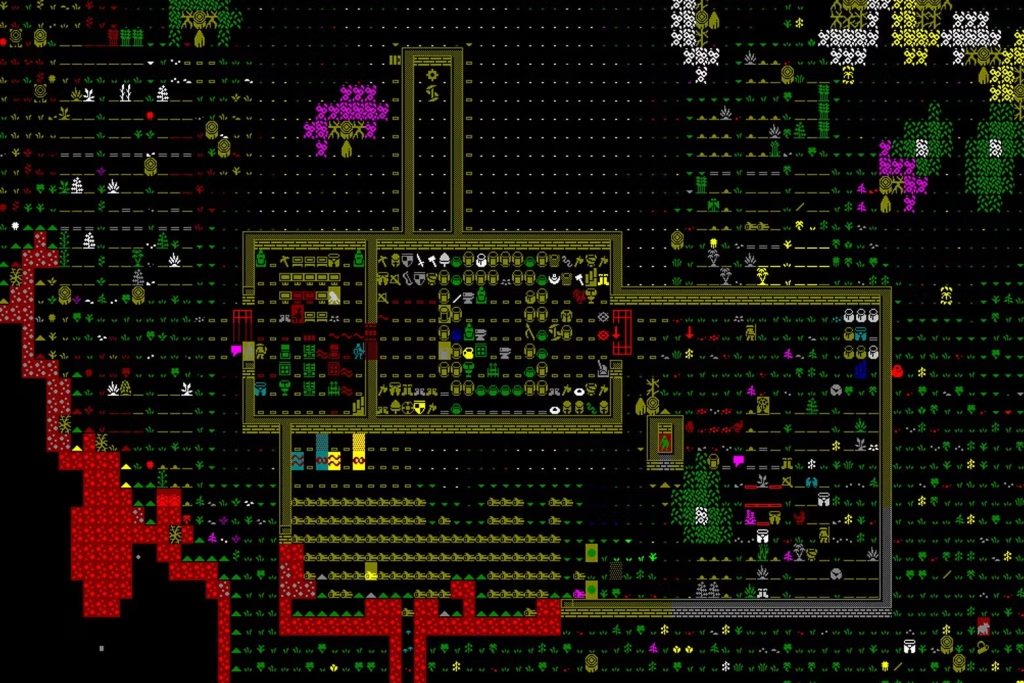
A: The way I think about games is not as these discrete objects that are separate from reality, the “magic circle” (thinking of Johann Huizinga’s book Homo ludens1), and more just a continuation of other things. Games and reality are one and the same to me. I’m passionate about understanding reality, and games are a prism through which to explore that passion. Games crystallize aspects of reality, but also reflect it back in turn, becoming powerful intuition pumps for how we interface with reality. We see this historically too. Games of chance inspired probability theory, puzzles and ciphers prompt discoveries in maths and are used for divination, chess and go instrumental for A.I., game theory… the list goes on. The creators of Dwarf fortress were once asked if they would ever get bored of making the game, and they said something to the effect that they would have to get bored of reality for that to be the case. Because games simulate, they are reality and a microcosm of it.
Q: Can “overanalyzing” can be considered a form of playing and what this implies for how we view “The game” and “The playing” in general?
A: This is a great question… and Yes! “Overanalyzing” is a form of play in my opinion. An easier way to reframe this question is that “thinking” itself is a form of play. We see this with people who play blind chess, they host the rules and the decision tree of the game in their head. We see this with knowledge based games,where the revelation of the game is the progression. Frank Lantz2 calls games “the aesthetic of thought”, “the art of instrumental reason”, but so many other aesthetic traditions of play recognize this. Games foreground the machinery of thought. Its about strategy, calculation, optimization, problem solving. We anticipate moves before we make them, and we ponder games both inside and outside the confines of the game.
C.L.R. James wrote a seminal book called Beyond a boundary3, where he argues that what happens outside the field, in his case the cricket field, is instrumental in understanding the game itself. The metagame is the game in many senses. We scout players before we play them, but we also negotiate rules, mediate politics etc, all of which influences what happens within the field of play. It’s a fascinating question that there’s lots of literature about.
“Overanalysis” as i see it is a mode of play, and I’m being self deprecating in some sense, but thats the only way i know how to engage with games, going all the way back to my simple question about why pieces move the way they do in chess. I had to go beyond the boundary, overanalysis to indulge my curiosity, and i dont think ive changed much since then 🙂
Q: Amazing. It confirms how much we have in common in our approach. One of our programmatic manifestos is called “There is no metagame” (available here). The central concept is that distinguishing between a “game” as a central, more meaningful experience that exists only within the predefined space of the game and a “metagame” as related activities that take place outside of it. It is a distinction that undermines the cultural value of game and play. What is missing in the world of “game” for it to have the same status as other media in public debate?
A: The public consciousness surrounding the word game, its legitimacy as a medium and how we communicate about it is really interesting. Of course, we could look at the literature on how we define games, going back to Wittgensteins idea of language games4. As a side note, a paper by Arjoranta surveys the history of this idea and the misconceptions around it.
One way to think about definition is that it itself is a game, a form of play, that is mediated by use, function and political expediency. What is considered a real game is always in flux, like so called walking simulators when they first came to prominence. The book Real Games by Mia Consalvo5 goes over this history. The point is that there are ways people use terms that supercede our intellectualizing about it, and speaks to descriptive vs prescriptive approaches to the topic. This is part of being both within and outside the language game of “game” itself haha. Another book of interest is Play redux by David Myers6. It’s a really complex work about the reflexive structure of games and how our metacognitive abilities interfaces with it. Think of Godel, Escher, Bach7 but extended to play and games.
With all that said, none of this is relevant to people. In a broad sense, games have already legitimized themselves as an artfrom, but our language of articulation about them is perhaps still catching up. Something Nguyen brought up in the score i thought was quite fascinating was how rock climbing looks boring from the outside, but is enthralling from the inside. The aesthetic of games is in us, it is felt, not out there in the world. We cant show it to people, we have to experience it. Play being the primary lens of analysis above even the game or metagame is fascinating, but the hurdles that come with trying to conceptualize it so with all the baggage that exist is an interesting problem. In the public discourse sense, i think just bringing up games alongside other cultural artifacts and talking about them as contiguous with other modes of expression is already happening. Maybe instead of validating games or defining things discretely, we just treat them as we see them and see where that takes us haha.
Q: Games are a way of looking at the world, many have always said so, but when times get tough, when the darkest hour could come at any moment, shouldn’t we be dealing with more serious matters? Is it important to talk about games in general, for everyone, or is it only important for gamers and their free time, or for designers and their work?
A: This is a very complicated question that feeds into lots of things We talked about, but my broad answer is much more practical. At the end of the day, meaningful engagement with politics and civic activism is the only means of effecting change. The question then is how games can facilitate this. They can be pedagogical tools, they can convey themes and ideas and motifs, and perhaps even seed ideas of political change, but ultimately, it needs to transfer to action, and I don’t know exactly how this happens. Gonzalo Frasca wrote a essay on Video games of the oppressed8 many years ago, talking about the civic potential of games, and many more have written on its transformative ability, but how exactly this happens is up for debate.
Q: I know that this isn’t “my” interview and that I shouldn’t, but I can’t resist the temptation to give you a brief indication of the direction of my investigation before finishing this great conversation
My main interest lies precisely in the debate that has arisen around “Play matters”, the manifesto published by Miguel Sicart in 20149, focusing on the difference between “game” and “play” and how critical attention to the former ended up stifling the latter, ultimately repressing all those creative and transformative phenomena that play can expose. I think that underlying this issue lies something vital for addressing many problems of human existence and our history. And, what we are calling “overanalyzing” may perhaps help shed light on this background.
If “overanalysing” is a form of play, It could be described as a kind of play that activates a particular reflective state and vice versa. To me, this sounds very similar to what Thi Nguyen10 calls “reflective control” in his latest book The Score11 which, in my opinion, is ultimately the central mechanism that distinguishes the two forms of “play” that he identifies (striving and acknowledge).
This distinction is the pivot that Nguyen uses to try to reconcile the distinction between “game” and “play,” “rules” and “creativity,” ‘autonomy’ and “control.” The book is a great book from an analytical and descriptive point of view, but in my opinion, it fails to dig deep enough philosophically. The central point should be: what triggers this type of approach? What are the conditions that make playing a game possible in a certain, striving, way?
For Nguyen and all analytical thinkers, ultimately it is games that activate play, but in my opinion this is a circularity that I find sterile, and we should try to construct a different one. Playing a game, but really playing it and not simply following the rules, is only possible if we adopt a certain attitude. Ultimately, this was also Bernard Suits’ conclusion when he spoke of the lusory attitude12, something that Nguyen, not surprisingly, never mentions. Perhaps we can call this “playfulness,” I don’t know, I’m not sure. But I believe it is the same attitude that one adopts when “overanalyzing”. That is, when trying to understand a game in depth, savoring it in all its structural aspects, but not limiting oneself to them, while at the same time trying to expand it, to see what happens when it reacts with other elements “outside” the game itself. Trying to reach the core of the game not to make it the focus of the discussion but for bringing it over the boundaries of the game itself.
A: I’ve mentioned Sicart’s work on play matter and his distinction between play and playfulness in multiple videos, and I’ve brought up his view on ethics in the ethics of computer games and beyond choices in a video I recently did on the paradoxes of ethics in games, so I just read up on it!
Also funny that you bring up the score, because i just finished reading it the other day! [Q: It’s no coincidence that I took the title of the book from his reading recommendations.] I quite enjoyed it and thought it was a really accessible entry into thinking philosophically about games. You bring up a fascinating point about reflective play, as in when we are playing for deeper purposes we have to suppress it in the moment, and just strive. I think the work of gregory bateson on metacommunication might be of interest to you if you are not already familiar with it. Moreover, a concept from cultural studies called “double consciousness” might be applicable here, the idea that we have multiple identities we have to reconcile. Another book called The Proteus Paradox13, talks about online identity and persona, and how the real world seeps into our self concept is worthy of note.
Maybe there is a way we can exercise metacognition in the moment, and engage in striving play whilst being cognizant. I don’t know how the psychological literature will square on that, but it’s an interesting thing to look into. Thinking fast and slow by Daniel Kahneman14 is a seminal book going over our fast and slow processing systems in thought, and might be an entry point to look into stuff.
The attitude you are talking about, which suits mentions, the lusory attitude is definitely something that can be developed more I agree!, and i wonder if there is some work out here on it. Again, I will have to survey some of the literature on that. I think going into the literature on cognitive psychology but also the philosophy of mind is the direction to take. There is something called heterophenomenology, building on phenomenology, as well as post phenomenology, which is about examining subjective experience from the outside, and its transformation when engaging with non-human agents. Sicart himself has even written on it.
But I will circle back to an idea you mentioned about play. Maybe the answer lies in a cultural upheaval about how we think about play itself. We have the idea of homo ludens, and we have ideas like the Ambiguity of play from Brian Sutton-Smith15, the idea that play falls under different rhetorics at different times. Maybe our conceptualizing of play is bound by a set of structures that is not visible to us, and we have to reconstitute our idea of play. Redefining it though a language game about play itself. Maybe then it will become clearer how we ought to distinguish these things. I don’t know the answer, but I’ve found some obscure books on the topic:
- Dionysus reborn by Mihai Spariosu is a cultural history of play modes in the contemporary era and how it has shifted across modes of philosophical thought, from Fant to Foucault.
- Play as a symbol of the world is a work of Eugen Finck that perceives play as the means by which we ontologize reality itself, and builds of off phenomenological ideas.
- Then there is The play of the world by James Hans, that takes the ideas of Deleuze and Guattari to conceive of play
- Finally there is Play and the human condition by Thomas Hendricks, that proposes a consolidated unified view of play that should also be of interest.
All that is to say I don’t know the answer, but I suspect it is both more complicated and simpler than we think, and requires framing the problem before we can solve it.
1Cfr. Johan Huizinga, Homo Ludens, Einaudi, Torino 1964
2American video game designer of Universal Paperclip. He is the founding president, now president emeritus, of New York University’s Game Center. The quote came from a famous GDC Talk “Hearts and Minds” (available here) and It is the cornerstones of his approach to the topic
3Beyond a Boundary is a memoir about cricket written by Trinidadian Marxist intellectual C.L.R. James. Cfr. C.L.R. James, Beyond a boundary, Serpent’s Tail, 1994
4Language games theory was developed by Ludwig Wittgenstein in his 1953 book Philosophical Investigations. In this book he replaced the previous view of language as a “mirror of the world” or an “image of reality”: Wittgenstein replaces this theory with one in which the denotative character of language (i.e., the fact that a word corresponds to an object or state of affairs) is only one of its many functions, uses… in short, the denotative is only one of an infinite number of language games. Creating new languages is equivalent to creating new “forms of life”. What matters, in fact, is the use that is made of language; this is its meaning. Therefore, for Wittgenstein, it makes no sense to study linguistic phenomena in a general and generalizing way, disregarding the infinite possible uses of words. Cfr. Ludwig Wittgenstein, Ricerche Filosofiche, Einaudi, Torino 2024.
5Cfr. Mia Consalvo, Cristopher A. Paul, Real Games: What’s Legitimate and What’s Not in Contemporary Videogames, The MIT Press, Boston 2019.
6Cfr. David Myers, Play Redux: The Form of Computer Games, University of Michigan Press, Ann Arbor 2010.
7The reference here is on Gödel, Escher, Bach: an Eternal Golden Braid by Douglas Hofstadter: the book is a bestseller which, through illustration and analysis, discusses how, through formal rules, systems at different levels can acquire meaning even though they are made up of “meaningless” elements (like symbols, annotations, notes, etc.). The discussion focuses on the meaning of communication, how knowledge can be represented and stored, the methods and limitations of symbolic representation, and even the fundamental notion of “meaning” itself. Cfr. Douglas Hofstadter, Gödel, Escher, Bach: un’Eterna Ghirlanda Brillante, Adelphi, Milano 1984.
8Cfr. Gonzalo Frasca, Videogames of the Oppressed: critical thinking, education, tolerance and other trivial issues, available here.
9Cfr. Miguel Sicart, Play matters, MIT Press, Boston 2014.
10American philosopher and academic who rose to prominence in the field of Game Studies thanks to his book Games: Agency as Art, Oxford University Press, Oxford 2020.
11Thi Nguyen, The Score: How to Stop Playing Somebody Else’s Game, Penguin Press, London 2026.
12From Wikipedia: The lusory attitude is the psychological attitude required of a player entering into the play of a game. To adopt a lusory attitude is to accept the arbitrary rules of a game, even though those rules often make the experience more challenging, in order to facilitate the resulting experience of play. The term was coined by Bernard Suits in the book The Grasshopper: Games, Life and Utopia, first published in 1978, in which Suits defines the playing of a game as “the voluntary attempt to overcome unnecessary obstacles”. Cfr. Bernard Suits, La cicala e le formiche. Gioco, vita e utopia, Junior Edizioni, Bergamo 2021.
13Cfr. Nick Yee, The Proteus Paradox: How Online Games and Virtual Worlds Change Us—And How They Don’t, Yale University Press, New Haven 2014.
14Cfr. Daniel Kahneman, Pensieri lenti e veloci, Mondadori, Milano 2020.
15Cfr. Brian Sutton-Smith, Ambiguity of play, Harvard University Press, Cambridge 2001.
Nessun commento